Getting started#
To get started with pv_tandem you will need two (three) things:
Install pv_tandem into your python enviroment.
Define the one-diode parameters.
(Optinal) Irradiance data for a specific location.
The third step can be omitted if the specific device should only be modeled for standart test conditions (STC). To learn more about the modeling approach of pv_tandem see the modeling basics section
Basic Usage#
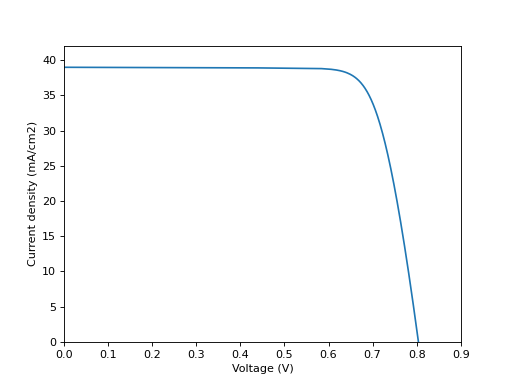
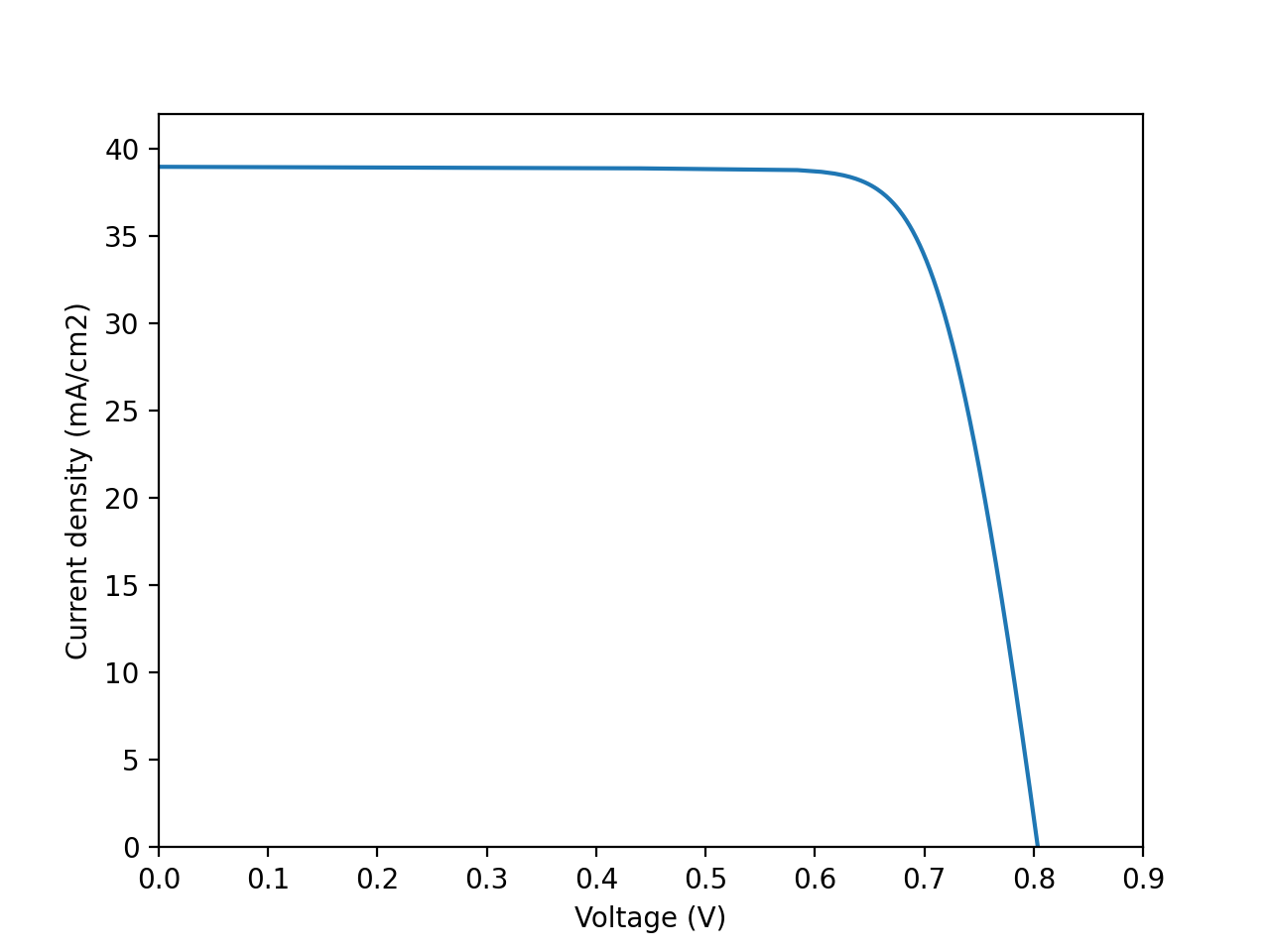
The basic requirement to simulate any solar cell with pv_tandem is to define the one-diode model with corespodning parameters, the absorbed photocurrent (Jsc) and the cell temperture:
import matplotlib.pyplot as plt
import numpy as np
from pv_tandem.solarcell_models import OneDiodeModel

one_diode = OneDiodeModel(
    tcJsc=-0.001, tcVoc=-0.0013, R_shunt=5000, R_series=1.5, n=1, j0=1e-12
)

j_arr = np.linspace(0,40,401)
voltage = one_diode.calc_iv(Jsc = 39, cell_temp = 25, j_arr = j_arr)
fig, ax = plt.subplots()

ax.plot(voltage, j_arr)

ax.set_xlabel("Voltage (V)")
ax.set_ylabel("Current density (mA/cm2)")
ax.set_xlim(0,0.9)
ax.set_ylim(0)
plt.show()
(Source code, png, hires.png, pdf)
You can find many examples in the Gallery that show how to simulate different types of solar cells and tandem with bifacial or monofacial illumination.